

Log collection, identification and routing

Every log in, identified, normalised and routed to the right SIEM.

APEX Log Stream sits between your log sources and your log platforms. It accepts syslog, HTTPS, webhooks and vendor APIs, recognises which firewall, server or cloud service sent each record, and fans each stream out to your log archive and your SIEM at the same time, each in its own format.

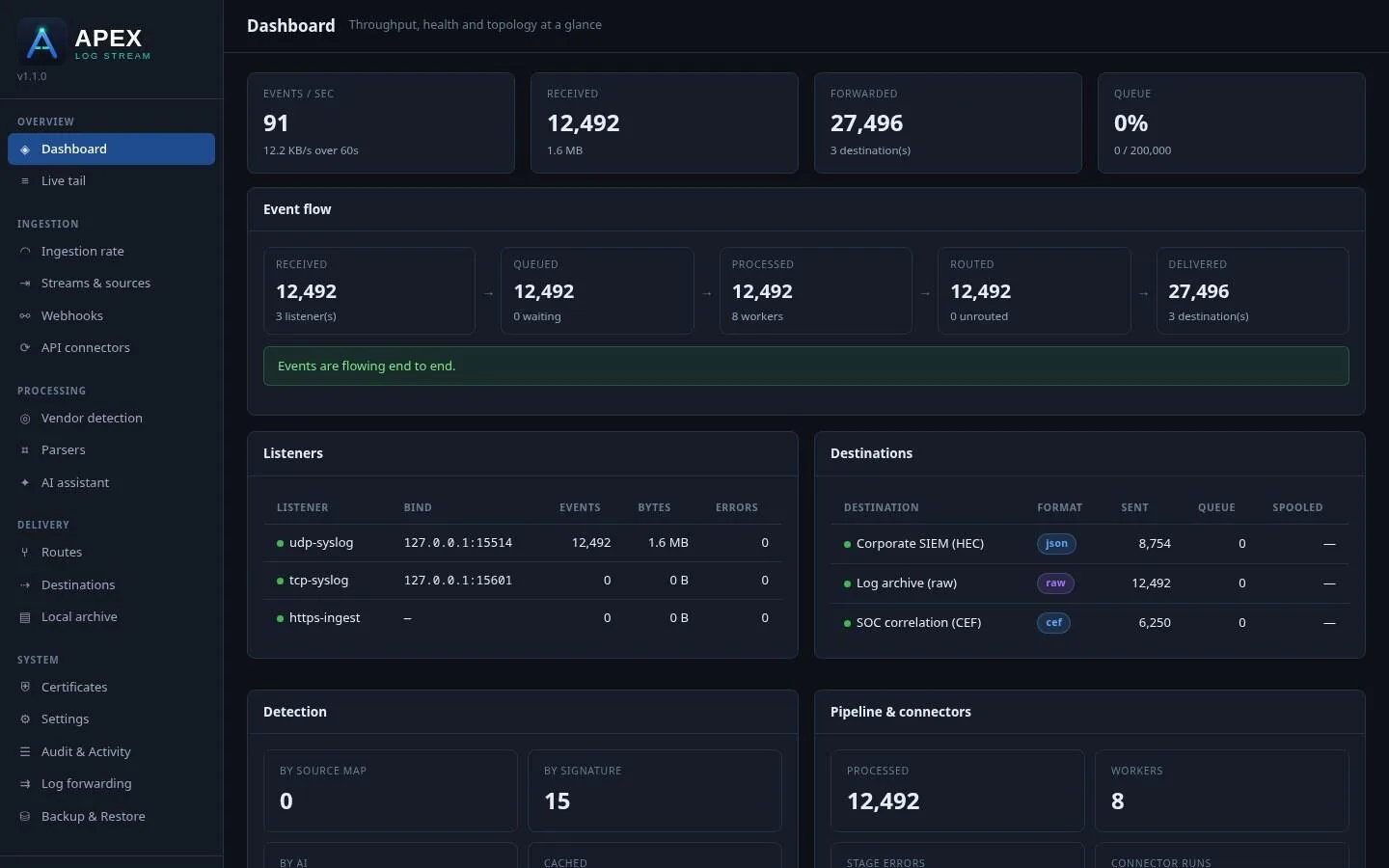
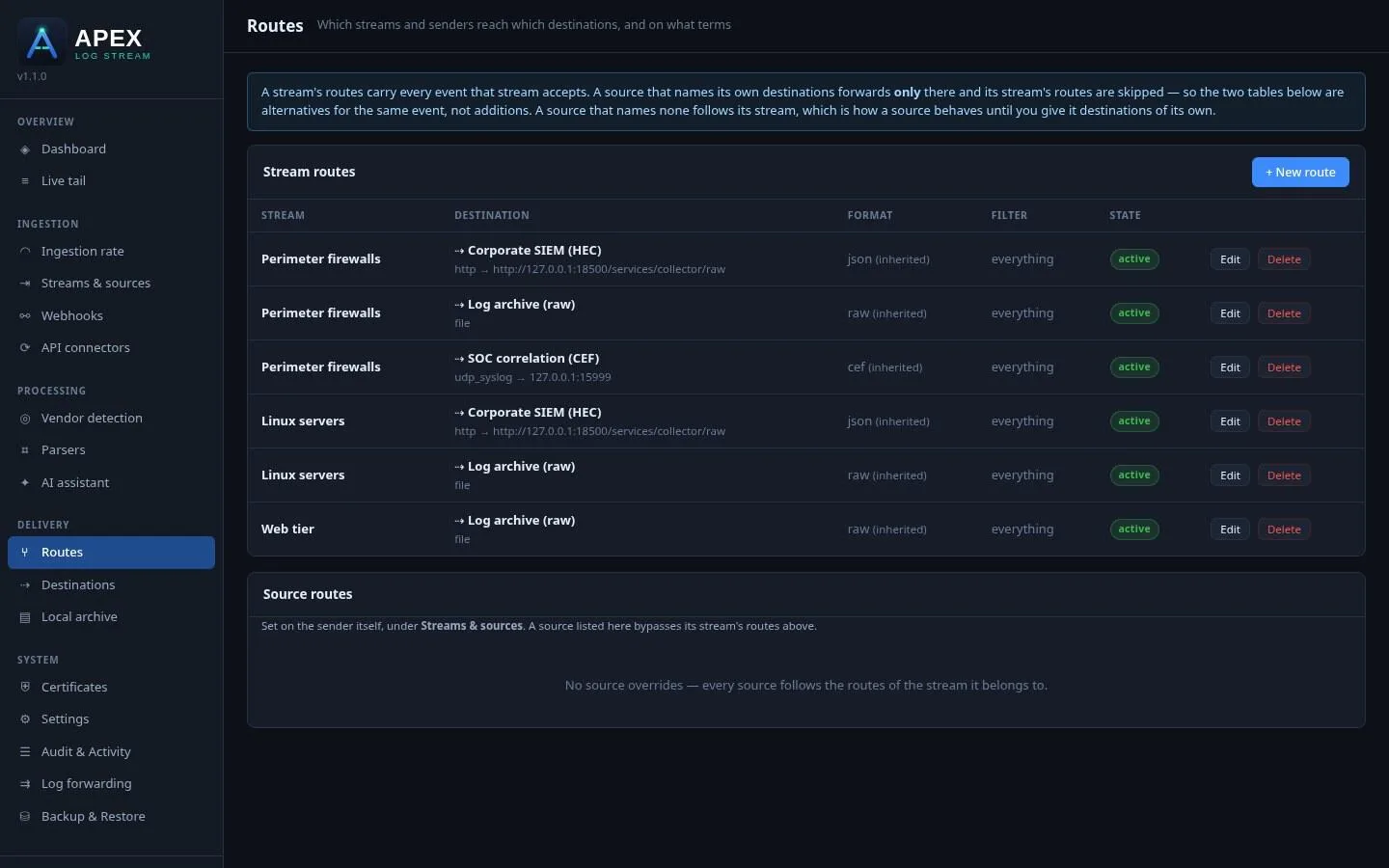
Screenshot of the APEX Log Stream dashboard with demo data: events per second, received and forwarded counters, the event flow from received to delivered, listeners and three destinations in JSON, raw and CEF formats
Product screenshot with demo data: throughput, event flow, listeners and destinations.
106built-in vendor signatures
55vendors with ready API feeds
5output formats per destination
4inbound paths: syslog, HTTPS, webhooks, APIs

Overview

The layer in front of your SIEM

Every firewall, server and SaaS product sends logs differently, and the same logs often have to reach a long-term archive and a SIEM in different formats. The usual answer is a tangle of per-device forwarding rules, relay servers and one-off scripts that nobody fully understands.

Log Stream replaces that tangle with one gateway. It identifies each record by the sender's address, then by content signatures, then optionally by an AI classifier. Records it cannot place are kept for review, never silently dropped. Each stream then fans out to as many destinations as you need.

The design rule behind it: the bytes that arrived are the bytes you can forward. Detection, parsing and normalisation only add information; a destination set to raw receives exactly what the sender sent. Cybercontrol can deploy and operate it as part of a SIEM engagement, or your team can run it on its own.

Capabilities

Collection, identification and delivery in one place

Every capability below exists in the current version of the product.

01

Every inbound path

Receive logs the way each source can send them.

  • Syslog over UDP (514), TCP (601, octet-counted or line framing) and TLS (6514, RFC 5425, optional client certificates)
  • HTTPS POST /ingest: single records, JSON arrays, NDJSON or text lines, gzip accepted
  • Webhooks per vendor with bearer, basic, HMAC, token or mTLS authentication
  • Explicit backpressure policy, with every dropped event counted
02

Automatic vendor identification

Know which product sent each record, without a rule per device.

  • Source mapping by IP, CIDR, hostname, webhook, path or connector
  • 106 content signatures: firewalls, web servers, IDS, endpoint, operating systems, cloud, identity and SaaS
  • Custom rules for anything the library misses
  • Optional AI classifier that proposes new rules for an operator to approve
03

Parsing and normalisation

Turn raw text into fields, and check the result as you build it.

  • Built-in parsers: key=value, JSON, CSV, CEF, LEEF, RFC 3164 and RFC 5424 syslog
  • A parser window that shows matches, captured fields and slow patterns live
  • Suggest-pattern and optional AI help, verified against your samples
  • Parsers per stream, per destination or per vendor and product
04

Fan-out to every destination

Send one stream to the archive and the SIEM at the same time.

  • Raw, JSON, XML, CEF or key=value per destination, with per-route overrides and filters
  • UDP, TCP or TLS syslog, HTTP(S) with batching, files
  • Its own queue and connection per destination: a slow SIEM never holds back the archive
  • Retries with backoff, and disk spooling replayed in order after an outage
05

Vendor API connectors

Collect from cloud and SaaS products that only offer logs through an API.

  • 67 ready feed templates for 55 vendors, from Okta and Microsoft 365 to CrowdStrike and CloudTrail
  • 15 authentication methods and 11 paging styles
  • Schedules or cron, with a cursor so a failed run is retried, not skipped
  • A Test button that shows the real response before anything is enabled
06

Visibility and control

Answer "why did my logs not arrive?" in minutes.

  • Live tail of every event as it is received, identified and routed
  • Local archive per stream with the sender, vendor and rule recorded for each line
  • Prometheus metrics and a dashboard of queues, spool and drops
  • Viewer, operator and administrator roles, two-factor sign-in, audit and activity logs, API tokens and encrypted backups

Inside the product

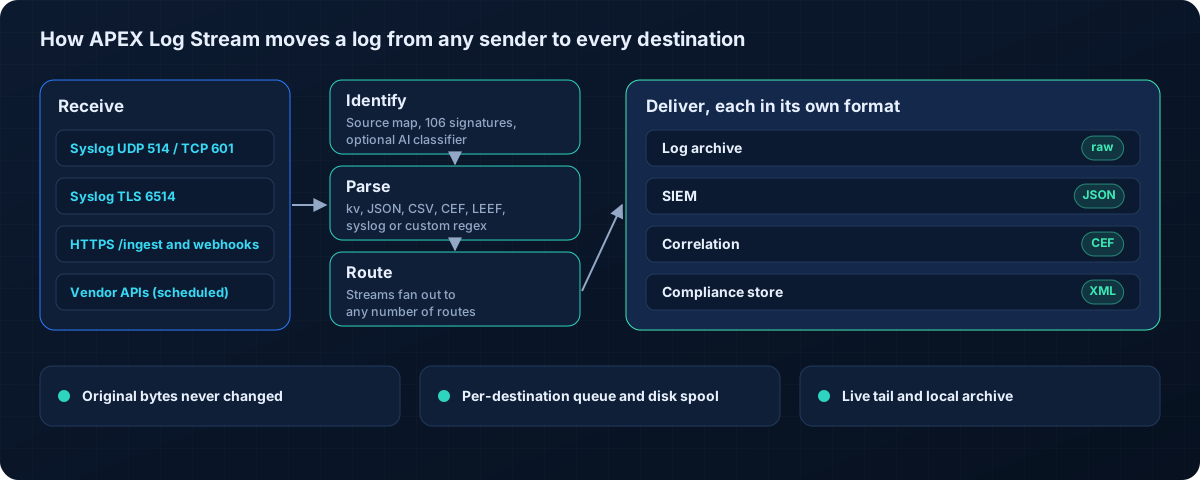
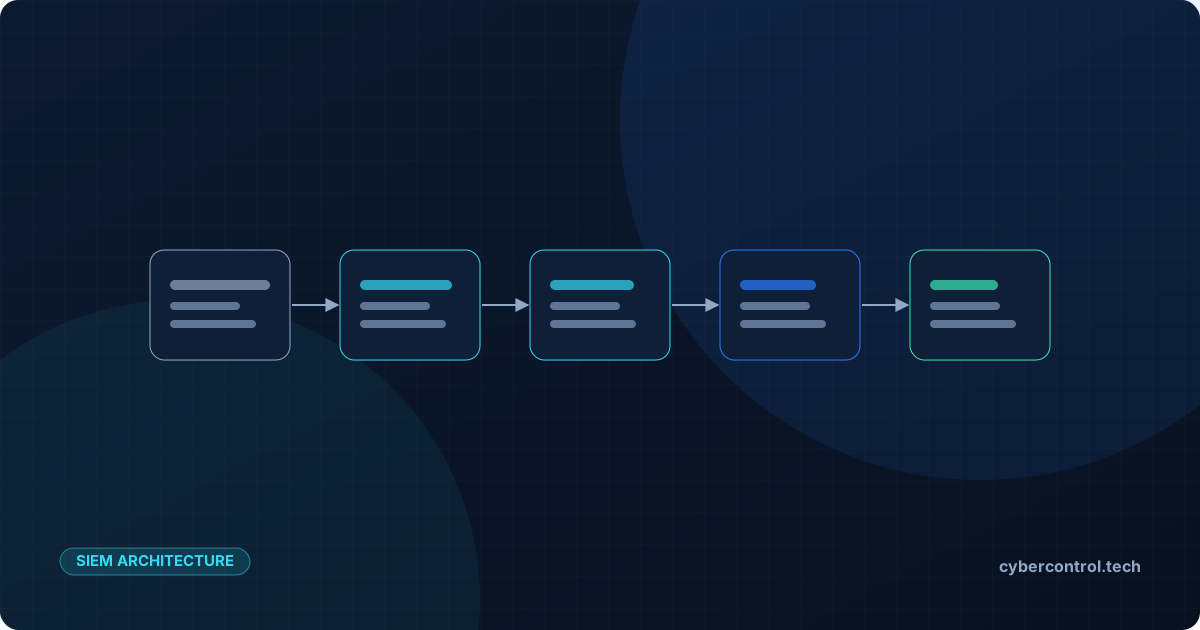
How a log travels through Log Stream

Receive from any source, identify and parse, then deliver to every destination in the format it expects.

Use cases

Who uses it, and for what

Feeding a SIEM

Bring firewalls, servers, endpoints and cloud services into the SIEM, identified and in the format its parsers expect.

Archive and SIEM at once

Keep the raw record for retention and investigations while the SIEM receives structured events.

SIEM migrations

Send the same sources to the old and the new SIEM in parallel until the new one is proven.

Troubleshooting log delivery

See in the live tail what arrived, from whom, what it was identified as and where it went.

Specifications

Technical specifications

Deployment and integration details of the current version (1.1).

On premises

Docker Compose with PostgreSQL on your own server, with every ingestion port, close to the log sources.

Desktop app

The whole product on one computer for labs, tests and troubleshooting, with the network listeners off until you turn them on.

InboundSyslog UDP 514, TCP 601 (RFC 6587), TLS 6514 (RFC 5425, TLS 1.2+); HTTPS 8443 /ingest; webhooks; scheduled vendor API pulls
IdentificationSource mapping, 106 built-in signatures, custom rules, optional AI classifier
Parserskey=value, JSON, CSV, CEF, LEEF, RFC 3164, RFC 5424 and custom regular expressions
OutputRaw, JSON, XML, CEF, key=value; UDP, TCP and TLS syslog, HTTP(S), file
ReliabilityPer-destination queues, retries with backoff, disk spooling, drain on shutdown
Connectors55 vendors, 67 feed templates, 15 authentication methods, 11 paging styles
Access and auditViewer, operator and administrator roles, two-factor sign-in, API tokens, audit and activity logs
OperationsPrometheus metrics, JSON logs forwarded to your SIEM, encrypted backups to local, SFTP and S3 storage
PlatformsDocker Compose with PostgreSQL on Linux; desktop app for Windows, macOS and Linux
Not includedLog ingestion in Cybercontrol's hosted environments: they offer the console and API, and senders connect to an on-premises or desktop installation

APEX Log Stream

Technical questions

Does it change our logs?

No. Identification and parsing only add information. A destination set to raw receives exactly the bytes the sender sent, so evidence stays intact.

What happens when our SIEM is down?

Each destination has its own queue. While it is unreachable its records are spooled to disk and replayed in order once it is back, and the other destinations keep receiving.

Does it send our logs to an AI service?

Only if you turn AI on. It is optional: with it off nothing leaves your network, and a local model keeps samples on your own host.

Does it replace our SIEM?

No. Log Stream collects, identifies and routes logs; detection, correlation and dashboards stay in your SIEM.

Get every log where it needs to go

Book a demo, or ask us to map your log sources and design the collection layer in front of your SIEM.

Contact

Let's talk about your security

Tell us about your company and what worries you. A specialist will reply with next steps and, if you want, schedule a free initial assessment or a product demo.

What happens next

  • A specialist reads your message and replies
  • A short call to understand your needs
  • A free assessment or a tailored demo

Sending opens your email app with the message ready. Nothing is stored on this website.